

Hey there, welcome to my very first post. Glad you found me.
I’m writing a book by the title “Darwin’s Wonders. An expedition to the grotesque world we live in.“ In my head it’s all there, and it’s quite something.
Now, all I need to do is write it down. But writing it down turns out to be a lot harder than it should seem, and that is why I start right here, on this Substack, with you. That way I can publish it in many small and not-so-scary steps, and revise it where it is needed. So please expect a rough sketch rather than perfectly polished chapters. After all, it’s an expedition, we never know where we end up. There will be rough winds, scary creatures and unfamiliar places. We might get lost a few times. Will be fun.
Setting sail for our wonderful world
So here’s the plan: we embark on an expedition into Darwin’s world and look for its wonders. I admit this may seem strange. It is, after all, a scientific theory we are talking about, “one long argument“, as Darwin called the Origin of Species. It seems an unlikely place to look for wonders.
Well, yes and no. Darwin and his contemporaries loved the strange and wonderful. Artifacts from every corner of the world arrived at their ports, and with them reports of exotic places and creatures that stretched the imagination. In his autobiography, Darwin recalls a book called Wonders of the World he had read as a boy, which first sparked his wish to travel the world1. The book lists a hundred wonders, including chapters on geological change, coral reefs, fossil vertebrates, the orangutan, and the fantastic zoophytes2 — all topics that would later resurface in Darwin’s own research.
So in this context, wonders are not opposed to facts. They are not the superstitious tales of the dark ages. They are facts and findings, documented by explorers and natural philosophers like Alexander von Humboldt. And that made them all the more fascinating. Unreal as these landscapes, creatures or artefacts may seem, they share the same planet with us, breathe the very air we breathe.
When Darwin speaks about the “wonderful facts“ he discovered, they are primarily facts, carefully described and illustrated according to scientific conventions. At first sight they are not that weird, really. But, after careful reflection, they begin to move. Their meanings shift. What seemed ordinary starts to shimmer with a quiet, unexpected life of its own. Take corals, for example.
Let’s talk corals
High on nature’s list of fancies sits the humble polypus. Each coral colony is formed by countless of these soft-bodied creatures. Their life begins as a drifting larva, which eventually settles on a hard surface, transforms into a single polyp, and begins to bud, forming a living colony. Thus, these tiny beings resisted classification as either plant or animal. They eventually earned their own place in between and were named zoophytes, Greek for “animal-plants.” So that was solved, only… there wasn’t supposed to be a place in between. The very existence of this little weirdo challenged the order of nature.
What is more, their calcareous skeletons remain after they die, forming the base for future generations to live on — the coral reef. A collective skeleton, home to a fantastic underwater world of lush colors and bizarre beings.
During his voyage aboard the Beagle, Darwin encountered atolls, rings of coral islands far out in the ocean. Inside lay a calm lagoon; outside, the reef plunged steeply into “unfathomable” depths. How? Darwin wondered. He observed, collected evidence, and reconstructed the story of their formation, much like a private detective piecing together a hidden chain of events from scattered clues.
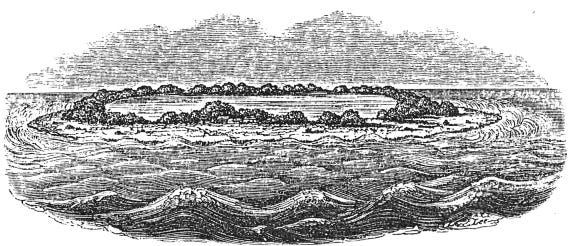
And here it is: Once upon a time, there was a volcano island. In the shallow waters surrounding it, corals could happily live in the sunny water, forming a perfect circle around it. Now let’s fast forward. We watch the volcano island sink, while the tiny polypus keeps building layer upon layer, always remaining just under the surface. Sloooooowly. Millions of years, thousands of meters of coral reaching all the way down to the bottom of the ocean. Until the island is gone and only the circle of corals is left behind. Voilá!
Darwin certainly seemed happy to add to the list of wonders, and wasn’t shy about giving it a top spot…
(…) such formations surely rank high amongst the wonderful objects of this world. It is not a wonder which at first strikes the eye of the body, but rather after reflection, the eye of reason. We feel surprised when travelers relate accounts of the vast piles & extent of some ancient ruins; but how insignificant are the greatest of them, when compared to the matter here accumulated by various small animals.
— Charles Darwin, Beagle Diary
The scientific endeavor reveals an image visible only to the ‘eye of reason’: a giant, submarine skeleton-sculpture built by generations of weird worms. And somewhere below, they are still building. After successfully defying classification as animal or plant, the polypus now blurs the boundary between biology and geology. Human beings are not the only architects of the world, and our monuments lose all their glory beside these organic ruins.
In the Book of Wonders he had read as a child, we were in charge. Its marvels were trophies of human achievement: things we discovered, explained or invented. Darwin’s wonders quietly undo that order.
The Darwinian Grotesque
During the course of our expedition, we will discover many more “wonderful facts“ scattered throughout Darwin’s publications.
Hermaphroditic barnacles that keep a tiny male in a pocket, little more than a bag of sperm. Just in case. A furry human embryo with a tail. Worms that cover the whole surface of the world in their fertile excrements. Ants building mock civilizations, farming aphids or holding slaves. “I am a complete millionaire in odd and curious little facts“, Darwin once wrote to a friend3.
And these odd facts are absolutely central to his work; they form the puzzle pieces of a new image of nature and of ourselves:
Hybrid creatures that blur the boundaries of plant, animal, and human
Death and decay as parts of a creative process of change and renewal
A world in motion, never still or harmonious but constantly becoming
Open bodies, interconnected with each other and their surroundings
Reversed hierarchies, the low and the earthly reclaiming their dignity
No higher plan, no purpose, only the ceaseless becoming of life itself
In other words: Darwin’s new image of nature is grotesque. And as such, it stands in sharp contrast to the classic ideals of Victorian England.
Dark and unsettling on one side, our world appears strange and unfamiliar; yet this very strangeness is freeing. It dissolves old pretensions, restores our kinship with the living world, and invites us to celebrate change and becoming.
Why it matters
I hope this expedition will be, first of all, fun. An actual journey, with a taste of freedom and adventure when we set out for new horizons.
Exploring the Darwinian grotesque will also reveal a new way of seeing the world, including ourselves. And this is the underlying philosophical motivation for writing this book.
Science has often been reduced to a mere tool. It helps us do things with nature. As such, it strengthens the opposition of subject and object. The subject of science is in full control, understanding and manipulating the world according to its wishes. Nature becomes a passive object, a material to be used, to serve a purpose. That is why the world seems mechanical and disenchanted.
Science as perspective, however, is a completely different story. It subverts the clean opposition of subject and object. As spectators, we are deeply, inextricably entangled with everything we see. Nature is not an object to be used. It looks back at us through countless eyes, all different from ours but related in our common history. This is not only a more humble position for humankind, but also a much more colorful and exciting world to live in.
And so, to my own great surprise, my engagement with Darwin turns out to be part of a lifelong search for perspective. And now I found it, against all odds, and now all I need to do is write it down.
Thanks for joining me.
Charles Darwin, Recollections of the Development of my mind & character.
Rev. C. C. Clarke, The Hundred Wonders of the World.
Charles Darwin in a letter to Sir J. D. Hooker.