
When Darwin was about eleven, he came across a book called The Hundred Wonders of the World.
Its pages were filled with marvels from around the globe: volcanoes and mastodon bones, whole islands made of ice, hummingbirds, pyramids and concentric rainbows.
These wonders were not fabulous tales or ancient superstitions. Far from it. They were described according to the “best and latest authorities” and confirmed by “the concurrent testimony of enlightened writers.”1 They were wonderful facts.
In his autobiography, Darwin recalls reading it often, disputing its claims with the other boys.2 It was this book, he writes, that first inspired his wish to travel the world—a wish that ultimately came true with the voyage of the Beagle.
Among its hundred wonders, three pages are dedicated to zoophytes.
Zoophyte. The word itself is a hybrid, stitching together the Greek words for animal and plant in just a few syllables. Unlike anything young Charles and his friends had seen, zoophytes “unite the animal and vegetable kingdoms, so as to fill an intermediate space.”
First comes the small but “infinitely curious” freshwater polyp. It consists of a tubular, plant-like body, attached at one end to aquatic plants or other surfaces in the water, while the other end has a mouth surrounded by a crown of tentacles.
Harmless enough, on first impression, it is a fierce predator.
Its tentacles equipped with microscopic suckers, it can catch and hold on to a worm with just one arm, but uses all of them when swallowing its prey, “in order to absorb it the more readily.” Even a worm three or four times its own size can disappear inside, the polyp’s body stretching around the meal, like a snake around a small animal.
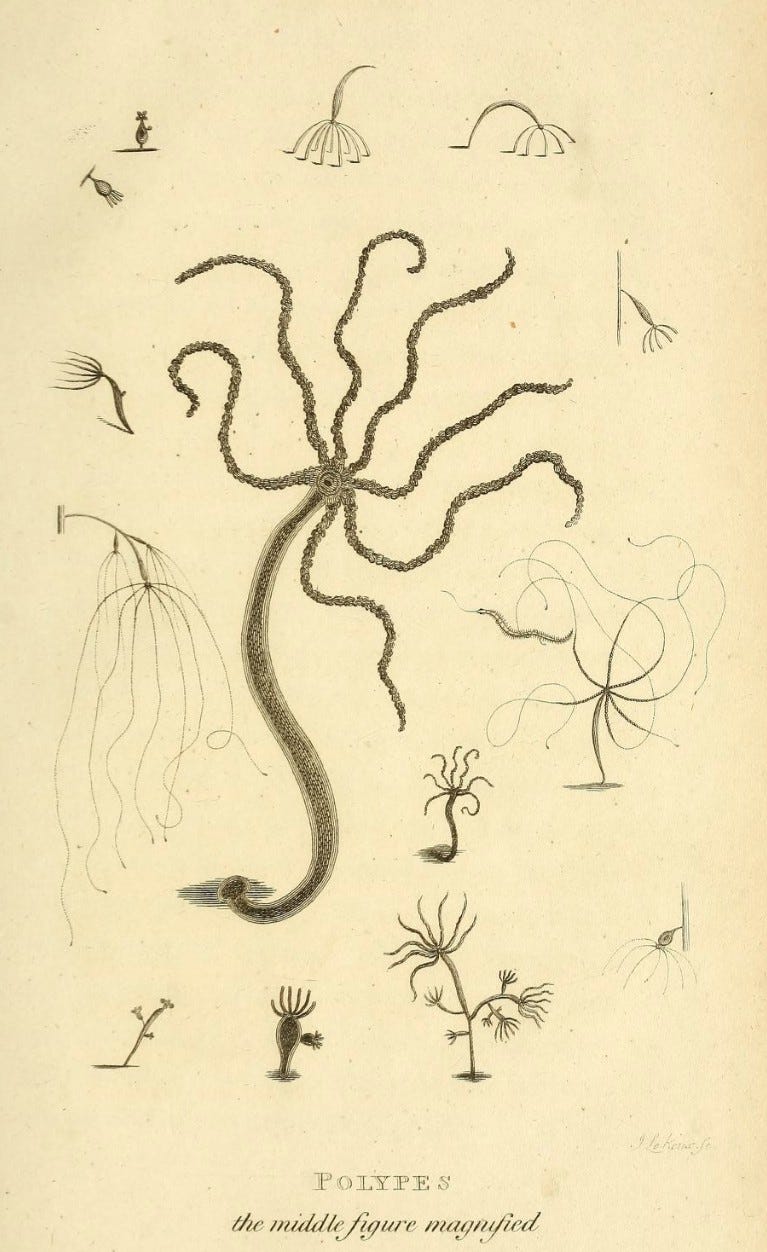
Stranger still, it can grow itself back. Cut the polyp in two and each half replaces what is missing: the head grows a new tail; the tail, a new head and arms. Cut it into three and the middle part grows both. All it needs is a few warm days. According to the book, it can be cut crosswise or in almost any other direction, and each piece will grow a body of its own.
Even without being cut, it produces new bodies. While the polyp lays eggs like an animal, it also reproduces through “shoots and offsets” like a plant. It grows new bodies much like other animals grow a limb: a bud swells from its side and gradually becomes another polyp, complete with a mouth and tentacles. Eventually, it drops away and begins a life of its own.
Birth, here, is a very public process.
Sometimes the offspring remains attached to its parent even as new branches begin to grow from its own body: three generations stuck in one body, “thus constituting a real genealogical tree.”
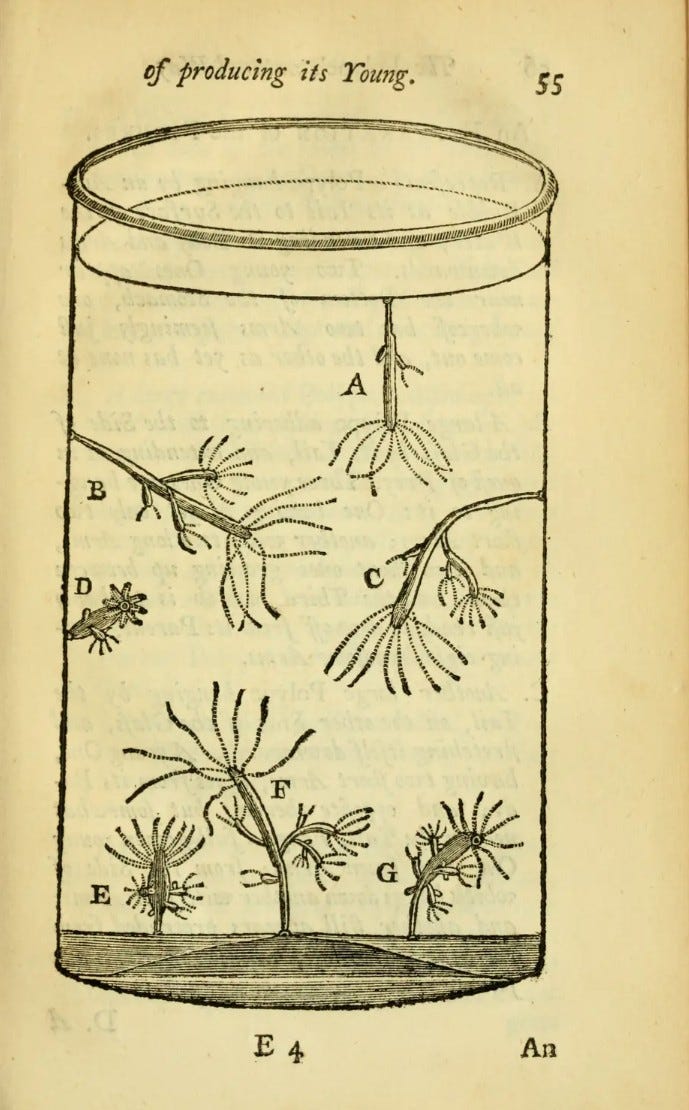
This living family tree is temporary: sooner or later, its branches separate into individual animals. But other polyps never part.
We know them as corals.
The book loosely differentiates between the smaller corallines and the hard or stony corals, but the principle remains the same: they are “so many ramified sea-polypes, covered with a kind of strong, horny case,” to protect them from the elements.
Body by body the coral grows, while secreting its hard shell, a permanent home “which may at once be considered its bone.”
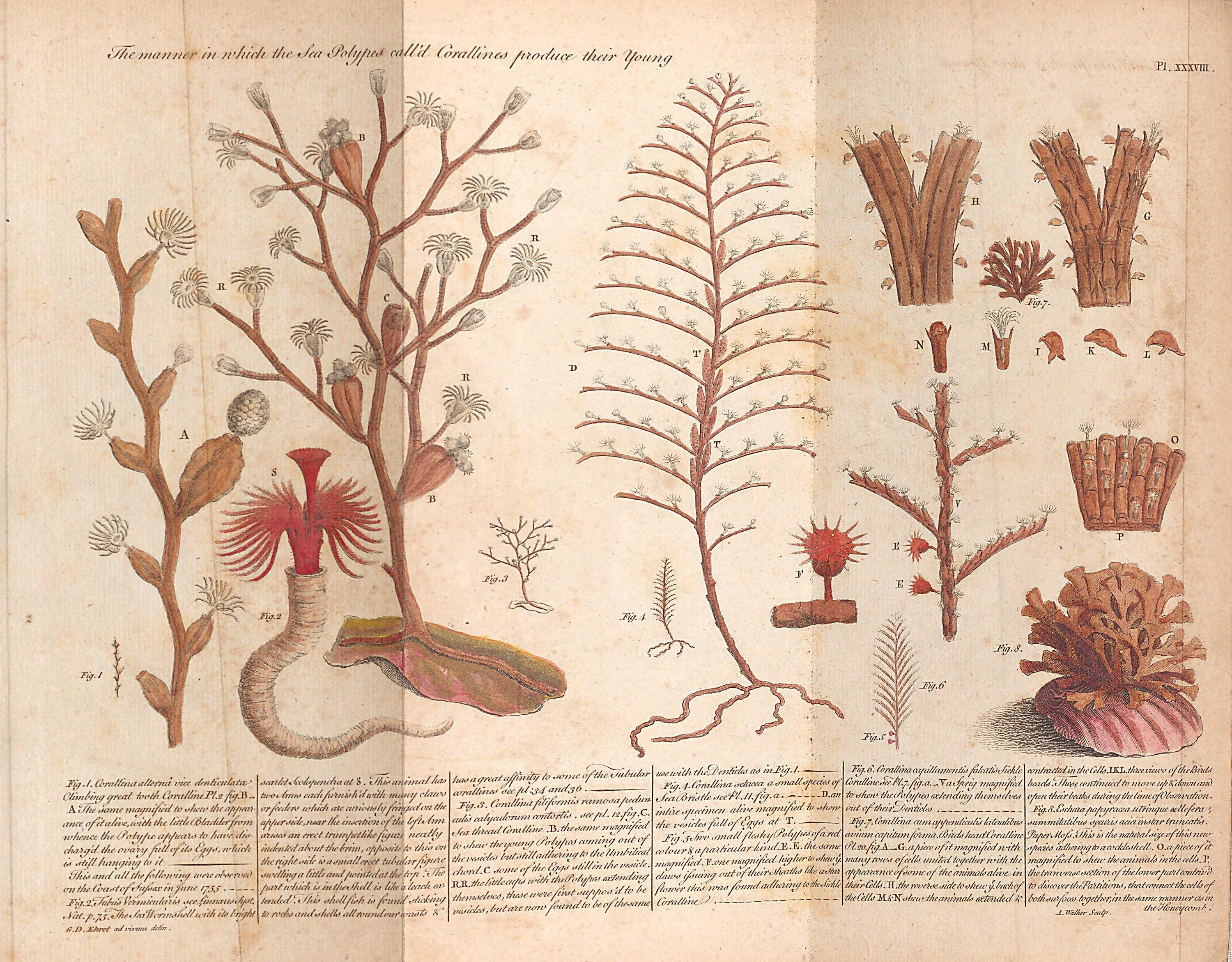
The illusion is complete. Place a freshly gathered twig of coral in seawater and tiny flowers appear to open from every cavity in its surface. But the blossoms are polyps, extending their tentacles to feed, and the twig is their shared skeleton.
A coral is therefore a “large compound zoophyte,” so many polyps joined together. A skeleton-tower inhabited by hungry worms. An animal-plant.
Could this be real?
The Edinburgh years
Whatever influence the book had on young Charles’s imagination, his early fascination with zoophytes is well documented.3 While supposedly studying medicine in Edinburgh, he spent much of his time by the coast, collecting marine creatures and taking notes.
In Robert Edmond Grant, Darwin found an experienced mentor who took him on collecting expeditions along the Scottish coast. For Grant, zoophytes were more than curiosities: they seemed to stand at the uncertain threshold of animal life, promising clues to its origins and development. Under his guidance, Darwin collected sponges and other marine creatures, learned to dissect them, and made precise observations under a microscope.
The zoophytes had left the page. They were now soft, living bodies, lifted from cold seawater and placed beneath a microscope. Instead of disputing a book’s claims with his school friends, Darwin discussed his own observations with the members of the Plinian Society, a student natural-history club. There he presented his first scientific paper, on Flustra, a zoophyte that looks much like seaweed. Its eggs, Darwin found, could swim.4
The Hundred Wonders of the World had offered him facts certified by authorities. In Edinburgh, Darwin learned how a wonderful fact was made.
By the time he boarded the Beagle, he had the eye and the tools of a naturalist. A world of wonders before him.
The polyp, its brethren
During the voyage, Darwin came upon zoophytes every bit as strange and wonderful as those he had read about. Two encounters were published in his journal.
The first was a sea pen at Bahia Blanca, Argentina.
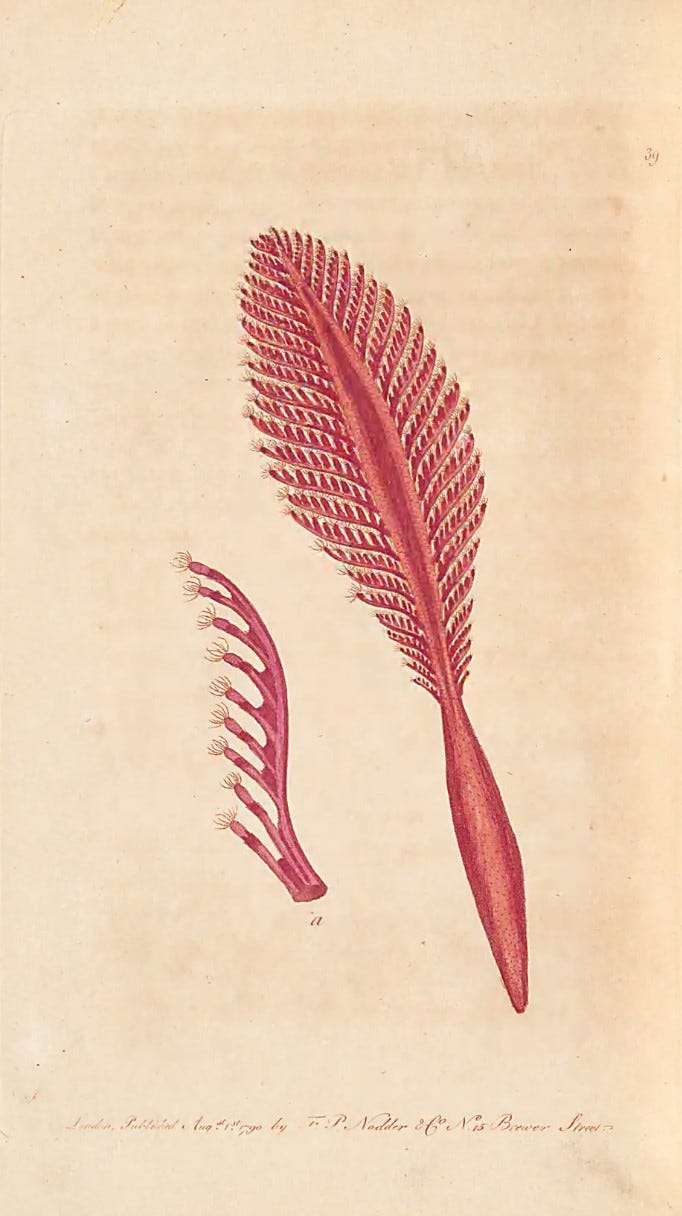
At low tide, Darwin found hundreds of them buried upright in the muddy sand, their yellow-orange tips “projecting like stubble.” A sea pen is a type of coral, though it takes an unusual form: a central stem with branches on either side, resembling a feather. When touched or pulled, the entire structure drew itself inward and vanished into the sand.5
Darwin was not the first to marvel at this behaviour. Alongside his own description, he quotes an earlier voyager, Captain Lancaster. More than two hundred years separate their accounts. Lancaster tells of a small twig that sank into the ground whenever he tried to pull it up, “unless held very hard.”
He makes no effort to hide his astonishment.
“On being plucked up, a great worm is found to be its root, and as the tree groweth in greatness, so doth the worm diminish; and as soon as the worm is entirely turned into a tree it rooteth in the earth, and so becomes great. This transformation is one of the strangest wonders that I saw in all my travels: for if this tree is plucked up, while young, and the leaves and bark stripped off, it becomes a hard stone when dry, much like white coral: thus is this worm twice transformed into different natures.”
A worm that becomes a tree that becomes a stone. The sea pen moves effortlessly through the separate realms of nature. It is wonderful precisely because it is a hybrid, three things that shouldn’t be one. A wonder worm.
Darwin’s description opens differently. The worm, tree and stone are still there, but rearranged into anatomical parts: a thin, fleshy stem surrounds a “stony axis” and ends in a “vermiform fleshy appendage.” The vocabulary is precise, the tone unhurried. Where Lancaster speaks of familiar things behaving in unexpected ways, Darwin names each part and fixes it in place.
Yet this new way of seeing does more than bring the same creature into sharper focus. On closer inspection, Darwin finds something Lancaster missed entirely: the seemingly single structure is composed of minute polyps.
“Each polypus, though closely united to its brethren, has a distinct mouth, body, and tentacula. Of these polypi, in a large specimen, there must be many thousands; yet we see that they act by one movement: they have also one central axis connected with a system of obscure circulation, and the ova are produced in an organ distinct from the separate individuals.”
The sea pen hovers between one and many. It is a colony of thousands of individuals. And it is one animal with thousands of mouths.
Darwin could not yet know how such colonies come into being.
It begins with one. A single larva drifts through the water until it settles in the mud. There it changes form and becomes the sea pen’s first polyp. As the polyp lengthens, its lower end burrows into the seabed, anchoring it in place, while the rest grows upwards to form the central stem.
Then a new polyp buds from its side, and then another. As they multiply, the sea pen’s feather-like form gradually emerges. Each birth is both the beginning of a new individual and the continued growth of the larger body they share. Some of the polyps feed. Others pump water through the colony, causing the entire structure to inflate and deflate like a single body.
In The Hundred Wonders of the World, we encountered polyps growing from each other’s bodies, temporarily joined before separating. Here, they never lose touch with their “brethren.” Each retains its own mouth, its own body, its own tentacles, yet remains permanently attached to the body from which it grew. Polyp and sea pen have become impossible to disentangle.
Darwin ends, inevitably, with a question: “Well may one be allowed to ask, what is an individual?”
Many more heads
In the course of the voyage, Darwin encountered an old friend: Flustra, the zoophyte he had studied in Edinburgh and made the subject of his first scientific paper. Years later and on the other side of the world, he returned to it with the same fascination, filling page after page of his zoological notebook with close comparisons of its different forms.6
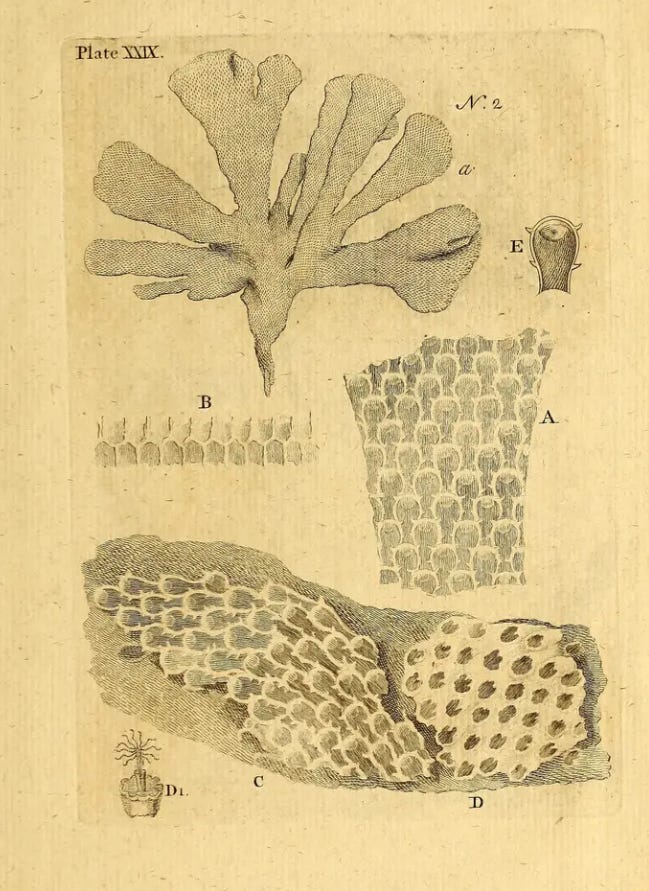
At first glance, Flustra resembles a brown leaf or a piece of seaweed. Up close, the apparent leaf resolves into a mosaic of tiny compartments, each inhabited by a living animal.
Some of the forms he studied held a further surprise: movable organs attached to the edges of their cells. In most cases, Darwin writes, this organ “very closely resembles the head of a vulture.”7 It sat on a short neck and possessed a lower jaw that could open much wider than a bird’s beak.
Darwin watched the heads move back and forth, sometimes slowly and rhythmically, sometimes rapidly and by starts. Their jaws opened and snapped shut. Minute as they were, they were remarkably forceful. When Darwin touched one with a needle, its beak seized the point so firmly that he could shake the whole branch.
Most of the time, each head moved independently. But sometimes all the heads moved together; sometimes only those on one side; and sometimes they moved in regular succession, one after another, like a wave.
In these uniform actions, Darwin notes, “we apparently behold as perfect a transmission of will in the zoophyte, though composed of thousands of distinct polypi, as in any single animal.”
Just like the sea pen, each polyp is distinct. Yet they act as one.
Faced with this riddle, Darwin reaches for a surprising comparison. A tree, he suggests, is likewise a body composed of many individuals.
Surprising as this union of separate individuals in a common stock must always appear, every tree displays the same fact, for buds must be considered as individual plants. It is, however, natural to consider a polypus, furnished with a mouth, intestines, and other organs, as a distinct individual, whereas the individuality of a leaf-bud is not easily realised; so that the union of separate individuals in a common body is more striking in a coralline than in a tree.
The zoophyte is not an exception, but an unusually vivid expression of a more general principle. In both polyp and bud, “the division of the individual has not been completely effected.”
Every tree, it turns out, is a genealogical tree. Its unity fragmented by so many births.
All of life
The final zoophyte in this story was not lifted from the sea. It appeared on paper.
Darwin’s books were often richly illustrated. Yet his main work, On the Origin of Species, contains only one illustration: the famous diagram of species. Too large for the page, it folds outward, leaving its right-hand branch visible as the reader turns the pages. As if life, in its ceaseless growth, had crawled out of the book that explains it.
The diagram is a system of classification, but it is also an instrument for seeing beyond the span of a human life. It reveals a history of descent otherwise invisible.
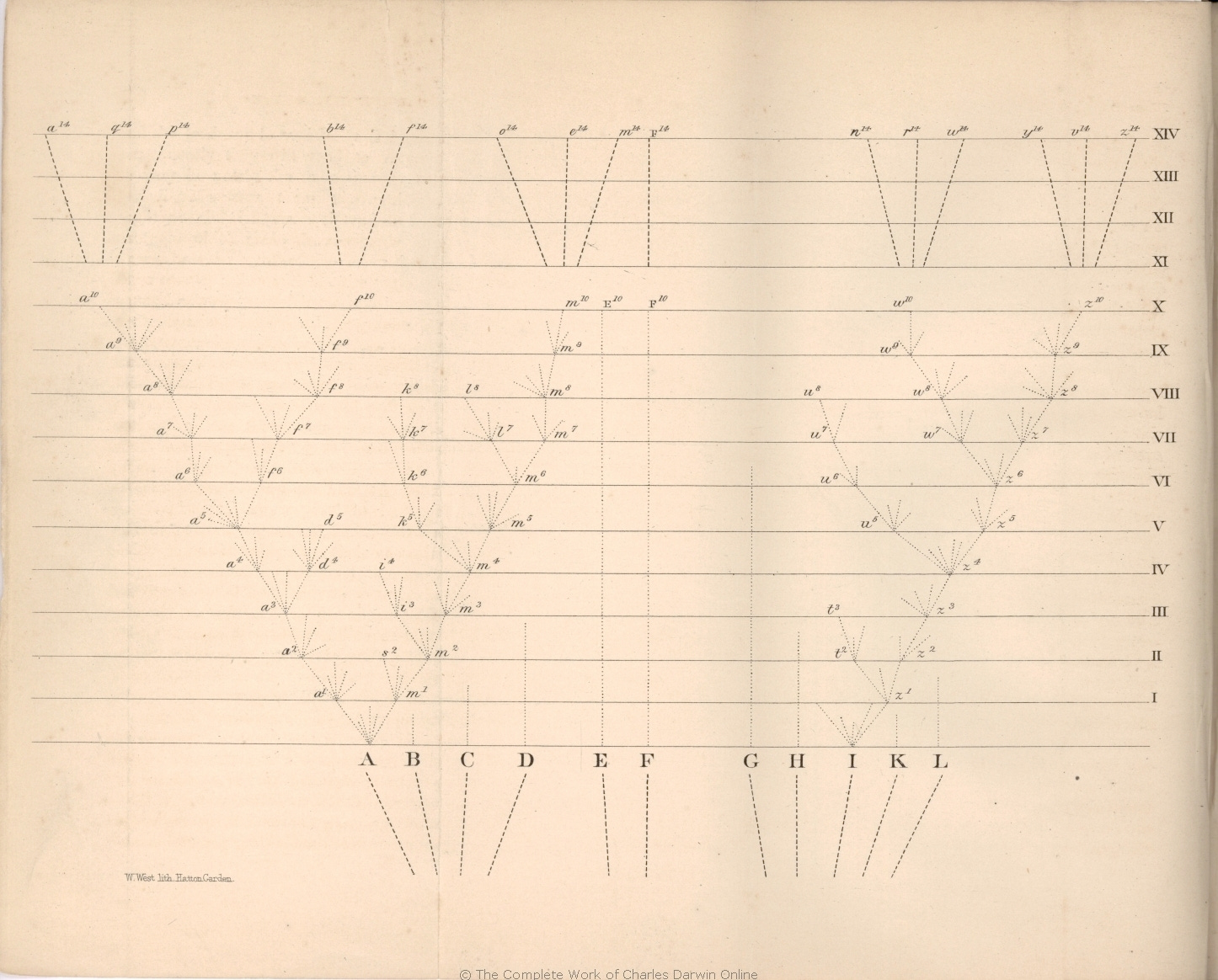
Begin at the bottom. The capital letters represent different species of the same genus—related, but different enough to be clearly distinguished from one another. Time moves upward, with each interval between the horizontal lines representing a thousand generations. The dotted lines trace their descendants, branching as small differences accumulate from one generation to the next. Some branches continue; others end.
Now follow species A. After a thousand generations, its descendants have diverged into two varieties: a1 and m1. These become the starting points for further branches. After ten thousand generations, A has given rise to three distinct forms—a10, f10 and m10. Depending on how much change has accumulated along the way, they may still be varieties of the original species—or have become distinct species in their own right.
One species becoming many.
But Darwin doesn’t stop there. The same horizontal lines, he notes, could just as well mark a million or a hundred million generations.
Welcome to deep time.
At this scale, the diagram no longer shows only species branching into species, but moves up the ladder of biological classification: from species to genera, families, orders and classes. The small tree we have followed becomes a single branch within a much larger structure. A tree inside a tree.
Darwin marvels at the sheer scale of what has come into view:
“It is a truly wonderful fact—the wonder of which we are apt to overlook from familiarity—that all animals and all plants throughout all time and space should be related to each other in group subordinate to group, in the manner which we everywhere behold.”8
All animals and all plants, throughout all time and space. Taken to its widest scale, the diagram traces life in its entirety, from a single origin outward. It shows what the zoophytes had already suggested: one plant-like organism composed of countless individual bodies. Only this time, the organism is life on Earth.
Darwin gives this immense structure a familiar name: the Tree of Life.
He compares his diagram to the genealogical tree of an ancient and noble family, which allows us to trace “the blood-relationship between the numerous kindred.”9 The difference is one of scale. The Tree of Life encompasses every animal and plant; the ancient and noble family is a tiny twig on it. Classification becomes genealogy, and genealogy becomes the history of life.
On the body of a zoophyte, family ties remain visible: new individuals stay attached to the body from which they grew. Where offspring separate from their parents, that link is less obvious. The genealogical tree draws it back into view, joining separate lives into one continuous movement.
The Hundred Wonders of the World had gathered its marvels one by one: extraordinary things discovered, explained or invented by the brightest minds of the age. Darwin’s diagram offers a different order of wonder. It does not merely add another curiosity to the collection. It lets us see life as a whole—and with it, a new view of the individual.
Seen from this new height, the individual remains intact, with a body and history of its own. Yet at this scale, its boundaries blur into the larger pattern.
For the individual, birth and death still mark beginning and end. From the perspective of the whole, they are moments in an ever-unfinished transformation.
Life itself shapeshifting.
Richard Phillips, writing as Rev. C. C. Clarke, The Hundred Wonders of the World, and of the Three Kingdoms of Nature, 13th ed. (London: Sir Richard Phillips and Co., 1821), quotes are taken from the book title and preface. All later quotes are from the entry Zoophites, or Plant-Animals on pages 517 - 519.
Charles Darwin, The Autobiography of Charles Darwin, 1809–1882: With the Original Omissions Restored, ed. Nora Barlow (London: Collins, 1958), 44, Darwin Online.
Rebecca Stott describes Darwin’s Edinburgh years and the importance of zoophytes to his early scientific thought in Darwin and the Barnacle. She also situates his work within the broader Victorian fascination with marine invertebrates—creatures thought to hold clues to the origins and development of animal life while producing grotesque images, comical and unsettling at the same time. See Rebecca Stott, Darwin and the Barnacle (London: Faber and Faber, 2003); and Stott, “Darwin’s Barnacles: Mid-Century Victorian Natural History and the Marine Grotesque,” in Transactions and Encounters: Science and Culture in the Nineteenth Century, ed. Roger Luckhurst and Josephine McDonagh (Manchester: Manchester University Press, 2002), 151–81.
Phillip R. Sloan places Darwin’s Edinburgh research within a continuous programme of work on marine invertebrates extending through the voyage of the Beagle. He argues that this work supplied important preconditions for Darwin’s later transformist thinking. See Sloan, “Darwin’s Invertebrate Program, 1826–1836: Preconditions for Transformism,” in The Darwinian Heritage, ed. David Kohn (Princeton, NJ: Princeton University Press, 1985), 71–120.
Darwin’s paper, “On the Ova of Flustra,” does not survive, but its presentation is recorded in the minutes of the Edinburgh Plinian Society. The supposed “ova” were in fact free-swimming larvae, as Darwin later acknowledged.
Charles Darwin, Journal of Researches into the Natural History and Geology of the Countries Visited during the Voyage of H.M.S. Beagle Round the World, under the Command of Capt. Fitz Roy, R.N., 2nd ed. (London: John Murray, 1845), 99–100, Darwin Online. All quotations in this section are taken from these pages. The extended passage beginning “On being plucked up” is by Captain James Lancaster, quoted by Darwin on page 100; Darwin gives his source as Kerr’s Collection of Voyages, vol. 8, 119.
Discussing the specimens of Flustra Darwin collected in Tierra del Fuego in March 1834, Richard Keynes writes that he “engaged on an orgy of comparative anatomy” and anticipated a remarkable amount of bryozoan biology. Charles Darwin, Charles Darwin’s Zoology Notes and Specimen Lists from H.M.S. Beagle, ed. Richard Keynes (Cambridge: Cambridge University Press, 2000), xv.
Darwin, Journal of Researches, 201–3. All quotations in this section are taken from these pages.
Charles Darwin, On the Origin of Species by Means of Natural Selection, or the Preservation of Favoured Races in the Struggle for Life (London: John Murray, 1859), 128–30.
Interesting to read. I have read a lot of Alexander von Humboldt's text from 200 years ago and although with modern knowledge there were a lot of mistakes in science from back then, but it definitely is very fascinating and I've always love the detailed drawings from back then.
There's something very phenomenological in the movement you're tracing here. Darwins attention to the sea pen is close that the meaning of "individual" becomes a question. Each polyp is its own yet the whole thing moves together, a Gestalt. When his description brings him tot he point where he might need to reconsider his categories, I read that as a willingness to let meaning emerge from the encounter and change the terms of inquiry. "What is an individual?" is what comes from that.
And then the return to the tree... The weird animal makes the familiar tree strange again. Having encountered the polyps, he can return to a tree and question its individuality. That feels close to the phenomenological project - to attend to how things show themselves, including where they exceed what was a "settled" understanding. Wonder survives anatomical precision.