
Charles Darwin was born in Shrewsbury, England, away from the coast. His first encounter with corals was most likely on paper, in a book named Wonders of the World. It was a collection of a hundred marvels from around the globe, which he read as a schoolboy, discussing its veracity with his friends. In his autobiography, he recalled that this book first inspired his wish to travel the world.1
Wonders of the World dedicates three pages to zoophytes, a group that includes corals along with sea anemones and sponges. Zoophyte. The word itself is a hybrid, stitching together the Greek words for animal and plant in just a few syllables. Unlike anything young Charles and his friends had seen, these zoophytes “unite the animal and vegetable kingdoms, so as to fill an intermediate space.”
Corals were not animals and not plants, but both, bridging the otherwise separate realms of nature. And for good reason: the larva hatches from an egg and swims about, just like an animal, until it permanently attaches itself to the ground, transforming into a plant-like body with a mouth surrounded by tentacles.
It lays eggs, yes, but the gelatinous polyp also reproduces via shoots and offsets, as a plant does. It duplicates itself, again and again, until it becomes a colourful little forest of hungry mouths.
The polyp grows new bodies the way other animals grow a limb, until they drop off and live on their own. Birth, here, is a very public process. At times, the new offspring are still stuck to their parent while already producing new branches from their own bodies. Three generations in one body, "thus constituting a real genealogical tree."
Could this be real?
Whatever influence the book had on young Charles' imagination, zoophytes were at the center of his earliest scientific endeavors. While supposedly studying medicine in Edinburgh, he spent his days by the coast, collecting zoophytes and examining them under the microscope. There he presented his first scientific paper: moss animal eggs, he had found, could swim.
By the time he boarded the Beagle, he had the eye and the tools of a naturalist. The boy who read about wonders became the man who studied them.
The polyp, its brethren
When Darwin published his account of the Beagle voyage, he included two encounters with zoophytes. The first is a sea pen, found in Bahia Blanca.
Sea pens are a type of coral, though in an unusual form. Imagine a thick, fleshy feather stuck into the seabed. It looks like a single twig, gently swaying in the current. When touched, the entire structure pulls itself inward and vanishes into the sand.
Next to his own description, Darwin includes a quote from an earlier voyager, Captain Lancaster. More than two hundred years separate the two texts. Lancaster tells the story of a small twig he found, which sinks into the ground when he tries to pull it up, "unless held very hard."
“On being plucked up, a great worm is found to be its root, and as the tree groweth in greatness, so doth the worm diminish; and as soon as the worm is entirely turned into a tree it rooteth in the earth, and so becomes great. This transformation is one of the strangest wonders that I saw in all my travels: for if this tree is plucked up, while young, and the leaves and bark stripped off, it becomes a hard stone when dry, much like white coral: thus is this worm twice transformed into different natures."
A worm that becomes a tree that becomes stone. Lancaster has no category for what he is seeing, so he moves through several, one after another, none of them quite fitting. It is wonderful precisely because language is failing to contain it.
Darwin’s description opens differently. He speaks of a “stony axis,” truncated on one end, with a “vermiform fleshy appendage” on the other. The vocabulary is precise, the tone unhurried. Where Lancaster reached for familiar things and found them failing, Darwin employs exact terms and paints a detailed picture.
What he finds, on closer inspection, is something Lancaster missed entirely. The whole structure consists of minute polyps.
“Each polypus, though closely united to its brethren, has a distinct mouth, body, and tentacula. Of these polypi, in a large specimen, there must be many thousands; yet we see that they act by one movement; that they have one central axis connected with a system of obscure circulation; and that the ova are produced in an organ distinct from the separate individuals.”
The sea pen hovers between one and many. It is a colony of thousands of individuals. And it is one animal with thousands of mouths.
In the Wonders of the World, we saw polyps growing side by side, temporarily joined before separating. Here, they never separate from their “brethren.” Each one remains distinct — its own mouth, its own body — yet permanently part of something larger: a literal family tree.
Darwin ends, inevitably, with a question: “Well may one be allowed to ask, what is an individual?”
Compound bodies
Later, during his visit at the Falkland Islands, he encountered various types of moss animals. These are small and unspectacular, often mistaken for seaweed. Only on close inspection are they visible as colonies of tiny animals.
In his words, we can hear an echo of the Wonders of the World:
“What can be more remarkable than to see a plant-like body producing an egg, capable of swimming about and of choosing a proper place to adhere to, which then sprouts into branches, each crowded with innumerable distinct animals, often of complicated organizations?”
Darwin looks closer. Many of them share a common trait: a moveable organ attached to their cells, which, in most cases, “very closely resembles the head of a vulture.“
He studied them carefully, as they moved rhythmically back and forth, occasionally snapping their jaws shut. Despite their size, they fiercely attacked the needle Darwin poked them with, holding it so firmly in their beak that he could shake the whole branch.
Most of the time, they moved independently of one another. Sometimes they all moved as one. At times, only the heads on one side moved simultaneously. And sometimes, they moved like a wave, one after the other.
Here, in these uniform actions, “we apparently behold as perfect a transmission of will in the zoophyte, though composed of thousands of distinct polypi, as in any single animal,” Darwin concludes. Zoophytes remain both one and many.
Faced with this riddle, Darwin reaches for a surprising comparison. A tree, he suggests, is really no different from a zoophyte. Its buds are individuals, each one a separate plant, yet permanently joined to a common body. We do not notice this because a bud does not have a mouth or intestines. But the logic is the same: what we see as one organism is really a “union of separate individuals in a common body,” their separation never quite completed.
Every tree, it turns out, is a family tree.
Life, all of it (work in progress)
After the Beagle voyage, zoophytes disappear from Darwin’s work. There is, however, one more compound animal — at the very heart of the theory of evolution, hidden in plain sight.
On the Origin of Species only contains a single illustration: the famous diagram of species. It is a tool to visualize a change operating on a scale far beyond our imagination, the slow accumulation of small variations across thousands, millions of generations.
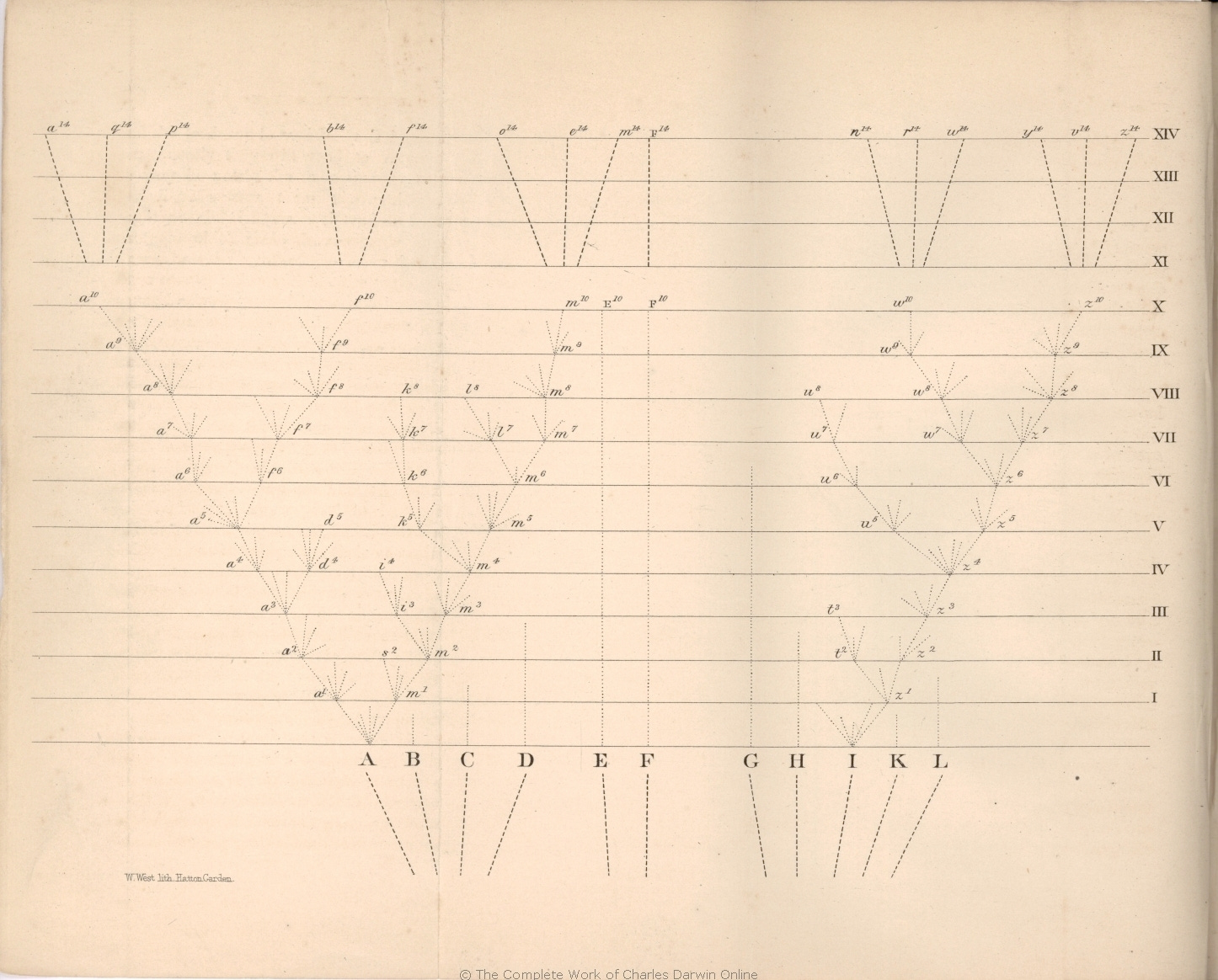
The letters at the bottom represent species, while the branching dotted lines above them trace how their offspring diverge over time. The horizontal lines mark the passage of a thousand generations. In the upward movement we see A transform into a10, f10, and m10.
Depending on the amount of change we suppose, these could still be varieties, or they might be species of their own. And that is how new species come about.
But Darwin doesn’t stop there. The same horizontal lines, he notes, could just as well represent a million or a hundred million generations.
Welcome to deep time.
With this change in scale, the diagram no longer just shows the development of species, but moves up the ladder of biological classification: genera, families, orders. The inner logic of the model is such that, given enough time, it can trace all of life, from a single origin outward.
On this scale, we can see all of life as one ongoing movement.
“It is a truly wonderful fact—the wonder of which we are apt to overlook from familiarity—that all animals and all plants throughout all time and space should be related to each other in group subordinate to group, in the manner which we everywhere behold.“
It is a genealogical tree scaled beyond recognition. The image of the Tree of Life, which he evokes alongside the diagram, highlights this unity of all life in one tree of descent. Each body distinct, and yet its family ties remain visible, linking it to something beyond itself.
Imagine your family tree, linking you to your parents, through them to your grandparents. That is three generations. Now imagine that this tree reaches much further, thousands, maybe hundreds of thousands of generations. Keep going, and you will eventually arrive at the common progenitor of all life, all of it. Along the way, you meet creatures that look quite unlike you, animals, plants, everything.
What we call individuals are not isolated units, but temporary formations within a larger continuity. They emerge, take shape, and dissolve again into the same process.
The question that began with the zoophyte — what is an individual? — returns here on a new scale. The individual becomes difficult to locate. It appears less as a fixed unit, and more as a fleeting moment within an ongoing transformation.
The diagram shows what the zoophytes had already suggested: one organism made up of countless individuals. In the big picture, birth and death are not beginning and end, but moments of one ongoing transformation.
The many wonders of the world are fleeting forms of one. Life itself shapeshifting.
Darwin mentions this book in his autobiography, stating that it inspired his wish to travel the world.
It was published in 1822, when Darwin was 11 years old, and contains a list of hundred wonders from the ‘kingdoms of nature‘.