
No better place to start our expedition than the sea. Waves in steady, tireless motion, washing up something curious now and then.
This time it was the shell of a sea snail, washed up on a beach in Chile. Darwin picked it up and inspected it with curiosity.
It wasn’t the snail itself that caught his attention, but a tiny hole in its shell leading into an oval cavity. Inside sat a minute, bright orange barnacle, smaller than a grain of rice, its three pairs of feathery limbs barely curled.
Barnacles were far from new to Darwin. He must have seen countless of them while studying in Edinburgh, and his notebook mentions a few individuals he encountered during the voyage of the HMS Beagle.
Darwin knew the familiar acorn barnacles, with their grey volcano-like cones, and the elegant goose barnacles, slim white shells on a dark, leathery stalk. When the tide returns, they open up and extend their feathery cirri, sweeping plankton from the passing water.
Barnacles, in other words, lived inside shells of their own. But not this one.
Darwin did what any good nineteenth-century naturalist would do with an unfamiliar creature: he bottled it up in spirits and added it to the growing collection aboard the Beagle.
Later, under the microscope, he found eggs and larvae in different stages of development.
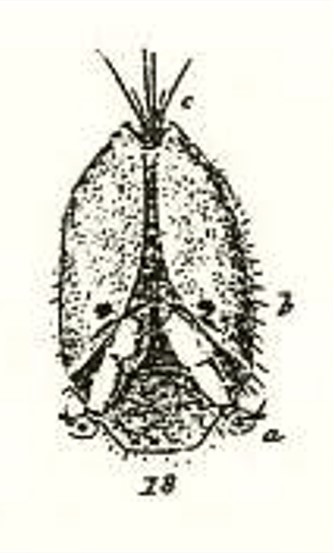
At first they appear as simple ovals. Soon tiny limb-like shapes begin to form. Finally they become coffin-shaped, with two jointed legs that can move and bend. The legs push out from the sides of the body, clumsy and oversized.
Only the most important step was missing: there was nothing linking the tiny larva to the adult animal.
Who would recognise this “ill-formed little monster” as a barnacle, Darwin wondered, adding that it “must clearly yet undergo a great metamorphosis.”
The barnacle years
After their return to England, the barnacle moved in with the Darwins in their country house in Downe. It sat patiently on a shelf in Darwin’s study, among other curiosities that were yet to be classified.
In his notebook Darwin had suspected that this was a new genus. However, the only way to prove this was to compare it with other species and see where it fit in the grand scheme of things.
Unfortunately, there was no bigger picture to rely on. The whole classification of barnacles was a frustrating mess, and Darwin decided to start from scratch.
He spent eight years studying barnacles and became the undisputed authority on these microscopic crustaceans. He dissected and studied them under the microscope, compared specimens, and organized collections sent to him from around the world. And while struggling with the sheer diversity, he got to know the barnacle more intimately than any naturalist before.
He was the barnacle guy.
In the end he was right. His Chilean barnacle, now by the name of Cryptophialus minutus, didn’t fit in and was its own genus.
But the wonderful facts he discovered were not exclusive to this rare curiosity. They belonged to all barnacles, even the most ordinary ones.
A body in transition
After years of intense study, Darwin knew that the metamorphosis of the larva — the “ill-formed little monster” — was characteristic of all barnacles.
What is more, he understood the “great transformation” that would turn it into its adult form.
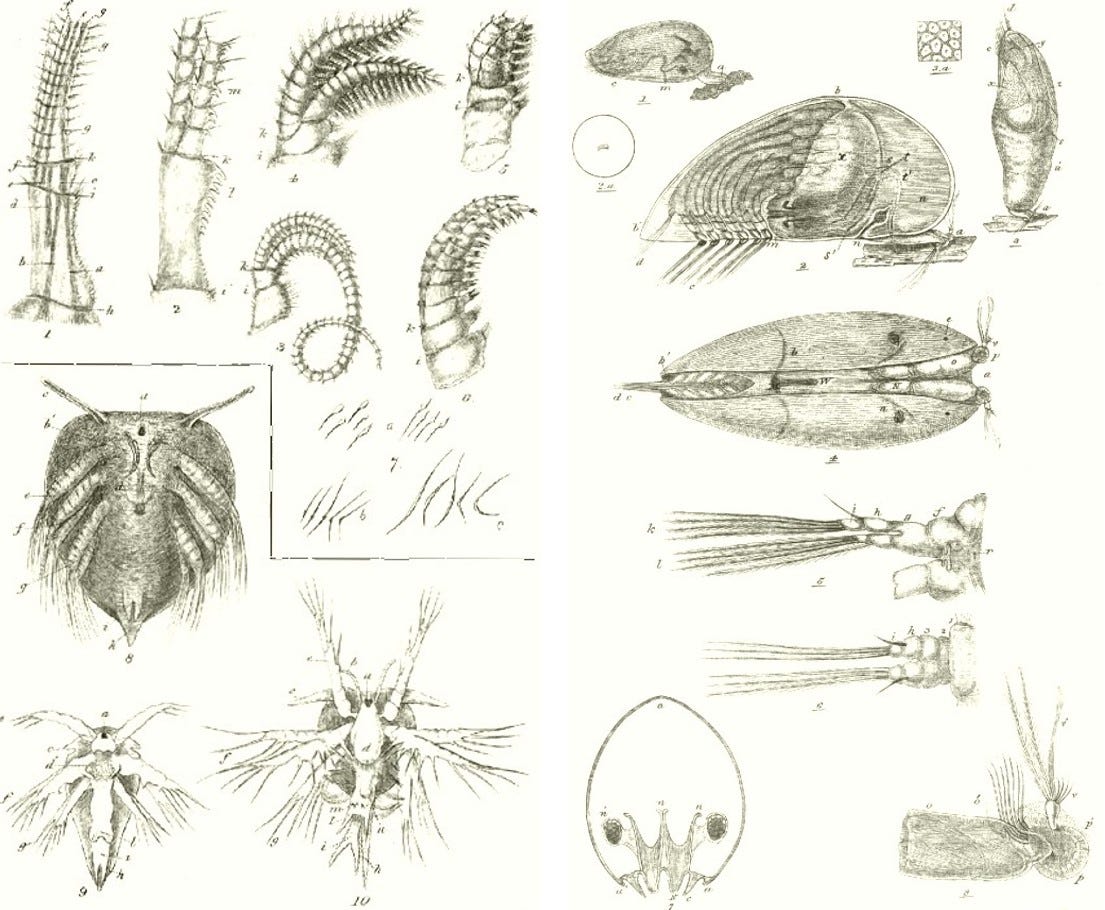
In its earliest stage, the larva is a tiny, oval crustacean, swimming freely in the ocean with its three pairs of limbs. It has a single eye and a functioning mouth, perfect for catching plankton drifting in the water.
After several molts it changes again, taking on a compact, coffin-shaped form. Two large compound eyes dominate its front, and six pairs of legs beat rhythmically through the water.
In this phase the old mouth becomes rudimentary and no longer functions. Feeding days are over. At the same time the mouth of the adult barnacle is already forming beneath it, though it has not yet opened.
Here, the larva carries both: a reduced organ from an earlier stage and the fully structured but inactive mouth of the next. Its body bears the traces of past and future metamorphosis.
Thus, with two mouths but unable to eat, it sets out to find a permanent home.
Its antennae change into grasping organs, connected to powerful cement glands. With these the larva tests surfaces, taps, withdraws, moves on. Until at last it finds a suitable spot and glues itself head-first to it.
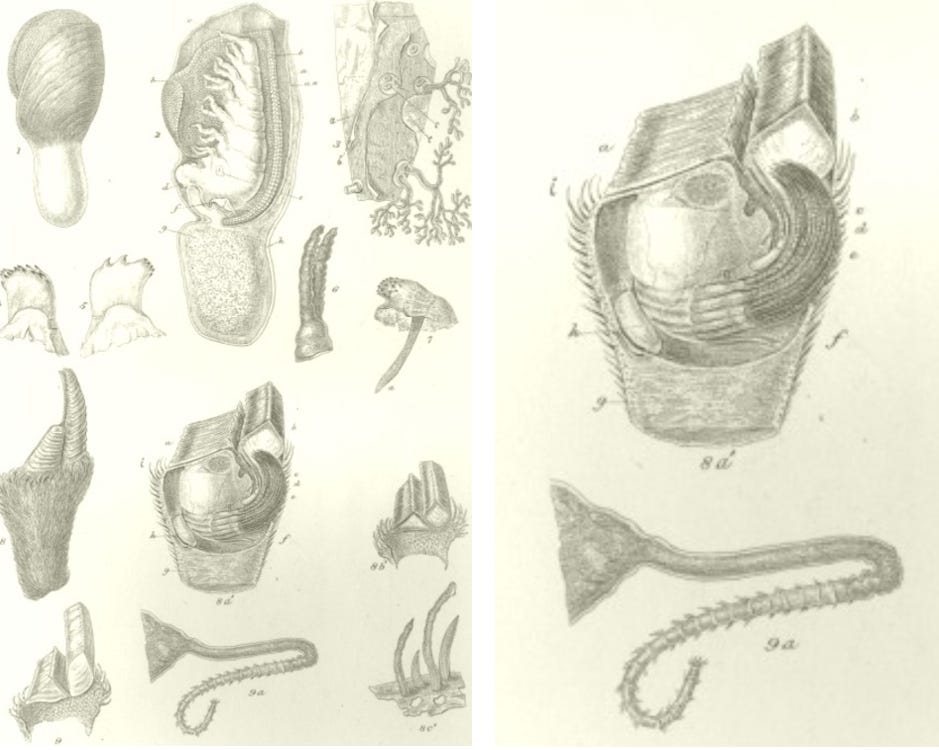
Now comes the final transformation. Once again the minute body rearranges all its parts to fit its new life. The swimming legs become the feathery cirri that sweep food from the water. The body turns into a soft, fleshy sack that houses the internal organs.
In barnacles that build their own shell, this sack extracts calcium from seawater and begins to grow the plates that will form its fortress. These plates can open to fish for food, or close to protect the animal from predators and dehydration.
It is now a body turned upside down, using its legs to kick food into its mouth while building a stony home around itself.
Barnacle anatomy is a moving thing, a story of change and becoming.
Complemental males
The mating habits are stranger still. To begin with, they possess the longest penis in the animal kingdom—or, as Darwin phrased it, a “probosci-formed penis capable of great elongation.”
Most species are simultaneous hermaphrodites: each individual carries both male and female organs, yet cannot fertilize itself. When the time comes, the animal extends its penis far beyond the safety of its shell, searching, probing, until it encounters a neighbor and transfers its sperm.
The body stretches far beyond its boundaries to connect with another. And that is not yet the strange part.
Darwin’s next discovery was so small and so unlikely that it took him a while to believe his own conclusions. And yet, there it was.
Some of the barnacles had tiny beings clinging to them. He had seen those many times and thrown them away, assuming they were parasites. But the closer he looked, the clearer it became that they were male barnacles.
They hatch from eggs just like the larvae, but their development is limited to, well, the male sexual organ and very little else. Tiny, even in barnacle terms, most of their organs were rudimentary or absent. In one species he found a male with no mouth or limbs, “but furnished with a stupendously long male organ.“
What exactly was this creature? Was it a very simple animal, or a reproductive organ swimming about on its own? Since in most cases, barnacles are hermaphrodites and don’t exactly need an additional penis (or more), he decided to call them complemental males.
Having the longest penis in the animal kingdom, keeping a few more may seem excessive. But barnacles, it seems, like to be prepared.
Like the larva, complemental males swim about freely at first, until they find another barnacle and attach to it permanently. Sometimes to the upper shell plates, right beside the opening. In other cases, Darwin found them inside the sack, fishing for food inside their mate, or even cemented directly to their bodies.
The barnacle is all of this: one hermaphrodite, its offspring in various stages of their development, and one or more males which “may, in fact, be said to exist as mere bags of spermatozoa.“
Darwin marvelled at what he saw:
What a truly wonderful assemblage of beings of the same species, but how marvellously unlike in appearance, did this individual hermaphrodite present!
Note how the individual becomes an “assemblage of beings“, an unlikely miniature underwater patchwork family.
The image of the barnacle dissolves into multiple simultaneous forms. There is no single creature one could point to and call the barnacle, only a shifting constellation of bodies linked by a shared life cycle.
Classification in motion
That Darwin highlights transformation and interconnection is no coincidence, and it isn’t simply an aesthetic preference. It is a necessity.
Looking at the different beings united in one barnacle sack, “marvellously unlike in appearance,“ Darwin remarks:
Unquestionably, without a rigid examination, these four forms would have been ranked in different families, if not orders, of the articulated kingdom.
There is no way to classify them correctly without understanding their relationships and the story of their development.
Most zoologists at the time focused on the completed adult body, leaving larval stages and metamorphosis aside. They believed in a common blueprint, an abstract archetype from which real specimens differed only to a certain degree.
This static view was the exact opposite of what Darwin saw. The radically different appearances of the same barnacle made clear that the archetype simply did not work. Otherwise, young and old, male and hermaphrodite might end up in entirely different families, if not orders.
The conflict echoes the one described by Mikhail Bakhtin between the classical and the grotesque image of the body. The classical body appears finished and self-contained, a stable form in which the traces of growth, decay, and transformation are carefully smoothed away. The grotesque body, by contrast, is never complete. It is caught in processes of development, metamorphosis, and exchange with other bodies. Its boundaries remain open and unstable.
Darwin’s barnacles clearly belong to this second world. Their identity cannot be grasped in a fixed form but only through the transformations that connect larvae, hermaphrodites, and dwarf males within a single unfolding life cycle.
Long before writing On the Origin of Species, Darwin had already begun to see the living world in motion. Any attempt to classify it would have to be dynamic.
The birth of the sexes
There is another theoretical twist to Darwin’s research, one that moves from the individual body to the very architecture of the species.
In the barnacle’s openness to change and becoming, Darwin saw that even the order of the sexes was not a fixed law, but a story in motion.
He noticed that the barnacles did not follow a single, tidy arrangement. Instead, he found a spectrum: species that were hermaphrodites, species with separate sexes, and the “wonderful” in-between cases where a hermaphrodite’s “masculine efficiency” was aided by those tiny, clinging complemental males.
Again, the various states become the still images of a transformation. Darwin proposed an evolutionary sequence that reads like a slow, biological dismantling. First, there is the hermaphrodite. Then, specialized males (the complemental ones) emerge simply by the loss of other organs. Now that males are abundant, the masculine parts of the original body become redundant. Evolution shrinks what is no longer needed and the female barnacle is born.
This explains why the males of these species so closely resemble those tiny complemental males, while the females appear identical to the hermaphrodites, simply stripped of their male organs.
Seen in this way, the separation of the sexes is not the default state of life, but a later development, a result of specialization and loss. It is the grotesque body at work: shifting its functions, shedding parts of itself, and rearranging its boundaries.
It is the story of a hermaphrodite whose penis swims away and becomes its own husband. Adam and Eve estranged.
Male and female are no longer timeless categories. They are derivatives of an older, unified form. Both are hermaphrodites that have lost half of their sexual organs.
Beyond the Shell
This shifting constellation of bodies—from the free-swimming larva to the sessile hermaphrodite and its parasitic males—shows the barnacle not as a thing, but as a movement and a „wonderful assemblage of beings.“
What began as a small curiosity in a snail shell turns out to be a creature whose life unfolds through constant transformation. A creature that challenges classification because it always looks different, depending on when you look.
Seen from the outside, the barnacle appears as nothing more than a hard shell glued to a rock. But under Darwin’s microscope it acquires a life of its own. What once seemed like a static object becomes a story — a sequence of forms unfolding through time.
It is a simple story and a familiar one: finding food, searching for a place in the world, building a home, and securing the next generation.
In this very moment, millions of barnacles are drifting through the ocean as larvae, testing surfaces for a place to settle, extending their feathery limbs into the water, searching for food, for a home, for a mate.
Fragile as they may seem, these creatures have conquered the world’s oceans through their tireless cycles of transformation.
Such bizarre creatures they are! And this time, I was reminded of jellyfish - porous, metamorphic, ancient, elegant and alien. I like how both really dismantle our assumptions that life forms are fixed, that identity is stable, that development is linear… the philosophical implication is also huge right? Because as humans we tend to experience ourselves as singular, continuous, moving forward through time, but these organisms suggest identity is more modular and distributed. Not a permanent structure, just a temporary arrangement. So damn fascinating ✨
Fascinating creatures these barnacles I can see why Darwin was so fascinated by them. Thank you for the recommend I look forward to your next post.