

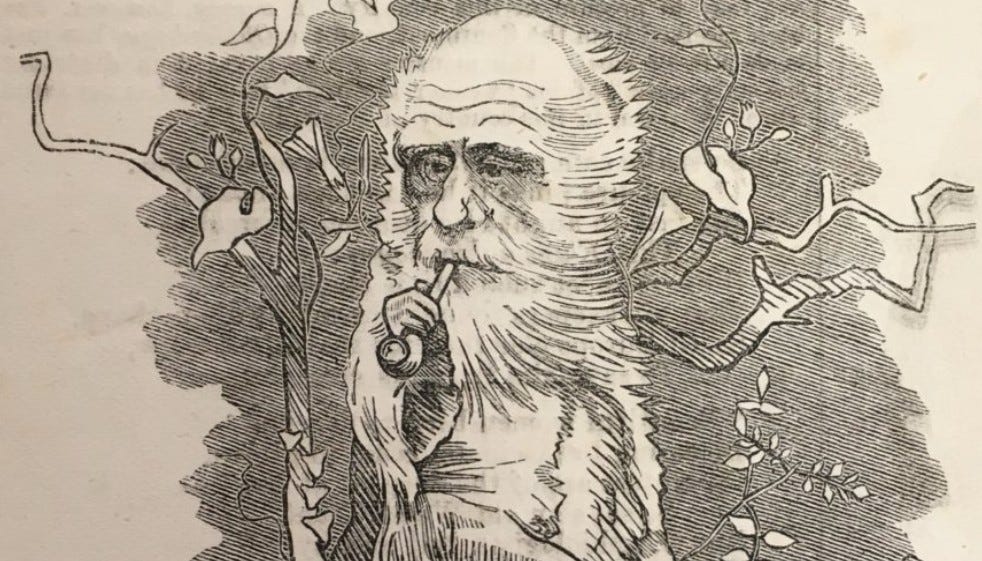
The theory of evolution is home to many wonderful facts. Strange beings that live at the very margins of our attention, whose world unfolds only under prolonged, systematic observation.
The love life of barnacles. Ants that hold slaves. A furry human embryo with a tail. Worms that cover the surface of the world in their fertile excrement. “I am a complete millionaire in odd and curious little facts,” Darwin once noted.
These facts are strange, yes — but strange in a very specific way. They are, in the best sense of the word, grotesque.
This may seem like an unusual claim. The grotesque is usually understood as distortion — ugly, excessive, unreal. But there is another tradition that describes something else entirely: a specific way of seeing life as transformation, as interconnection, as a process that never quite finishes.
So understood, Darwin's wonders are glimpses of a world in restless transformation, where boundaries blur, bristling with life.
That is the world this book sets out to explore.
But what exactly is the grotesque?
Most attempts to explain the grotesque place it in direct opposition to the sublime and the beautiful: ugly, misshapen, disproportionate. Its most iconic motifs are hybrid creatures, part human, animal or plant, disturbing the natural order of things.
The effect is disorientation. The world becomes unfamiliar, estranged.1 To this day, this is how the term is commonly used: as a stronger form of the absurd, marked by discomfort and rejection.
But this is only one side of the grotesque, Mikhail Bakhtin argues. And seeing the full picture radically shifts its meaning.
If the grotesque violates the order of things, that is because it unfolds its own. Far from being merely a disturbance, it follows an inner logic and has its own perspective. Bakhtin describes a conflict between two worldviews: the classical ideal of harmony and completion, and the grotesque vision of life as perpetual change.
These are not simply two aesthetic preferences. They are fundamentally different ways of seeing life, of how bodies relate to the world.
Grotesque vs. classical bodies
The grotesque body does two things: it changes, and it opens.
In Bakhtin’s words:
“Contrary to modern canons, the grotesque body is not separated from the rest of the world. It is not a closed, completed unit; it is unfinished, outgrows itself, transgresses its own limits.”
The grotesque shows bodies in a state of transformation — always giving and receiving, from other bodies and from the world. One line of exchange runs through eating and excreting: the world enters the body, is transformed, and returned. Another runs through sex, pregnancy, and birth: two bodies join, a third emerges.
It is no surprise, then, that the grotesque draws attention to the body’s openings — mouth, genitals, anus — and to the belly, the place of transformation. We take in, we transform, we give back. In the end, death marks a final transformation, dissolving the body’s boundaries and returning it to the earth.
The grotesque body is never at rest, and it is never truly individual. It exists as part of a larger, shared process of life.
Bakhtin helps us understand the hybrid creatures in a new way. Not as disturbances of the natural order, but as condensed images of the grotesque body, “blended with the world, with animals, with objects.“
The classical body is the precise opposite, unchanging and isolated, closed off from the world and from other bodies. Its openings are concealed, all traces of change and becoming are hidden. Attention is drawn to the surface of the body and to the face as the seat of personality. This is the body of the individual: stable, complete and self-sufficient.
No wonder that, measured against this ideal of classical beauty, the grotesque body appears ugly and out of place.
Down to earth
This opposition between two ways of seeing the world culminates in the central movement of the grotesque: degradation.
At first glance, the word may sound negative. Nobody wants to be degraded. But in Bakhtin’s sense, degradation is ambivalent. It destroys and renews. Anything high, abstract, and ideal is brought down to the material level of the body and the earth. To the belly, the genitals, the womb. To eating, sex, birth, and decay.
This lowering is not an insult; it is a homecoming. In the grotesque world, to be 'degraded' means to be returned to the fertile earth, the zone where life is made and remade. What is brought down is broken apart, yes, but only to become the raw material for something new. Here, the rot of the old is the fuel for the next metamorphosis. Destruction and creation are not opposites; they are the rhythmic breathing of a living world.
The classical ideal follows the exact opposite movement. It seeks to protect life from the chaos of change by lifting it toward the eternal. It strives for a beauty that is timeless and complete, providing a safe distance from the terrifying flux of existence. Everything that points to change, decay, or becoming is covered up. Here, the timeless ideal prevails.
A world in motion
The grotesque is not just a special type of weird. It is a world view of metamorphosis. And this is anything but abstract. Bodies change, the world changes. In this ongoing transformation, boundaries begin to dissolve.
Birth and death are no longer beginning and end, but two parts of a single movement. A continuous metamorphosis in which everything intertwines.
Seen from this angle, a Darwinian grotesque gains plausibility. Darwin's task was precisely this: to articulate a dynamic view of life in a culture committed to stable orders, fixed species, and self-contained individuals.
Some studies have drawn careful attention to grotesque elements in Darwin’s writing, such as barnacles or worms.2 While they are insightful, these elements remain isolated and risk becoming anecdotal, a curious footnote to evolutionary theory. Barnacles and worms are only two among many wonderful facts that form a coherent whole. To understand them is to enter the strange and wonderful world Darwin saw.
Footnote Kayser
Footnote Jonathan Smith, Ulin and Stott, Bowne.
Just reading back through your catalogue - nice read - where should i go next?
Excellent piece Michael, loved it. The whole time I was reading, I couldn’t stop thinking about slime moulds! Bizarre pulsating organisms that somehow feel both grotesque and sublime at the same time. They definitely unsettle our classical ideas of the body as fixed and coherent… they ooze (haha intended) between categories of organism and network, intelligence and instinct.. There’s something deeply beautiful to me about forms of life that reveal transformation itself as the natural state of existence ✨